Graphic design contract template
A graphic design contract settles four things before you start: what you are making, how many rounds of changes are included, when you get paid, and who owns the files. Here is what to put in yours, with wording you can adapt.
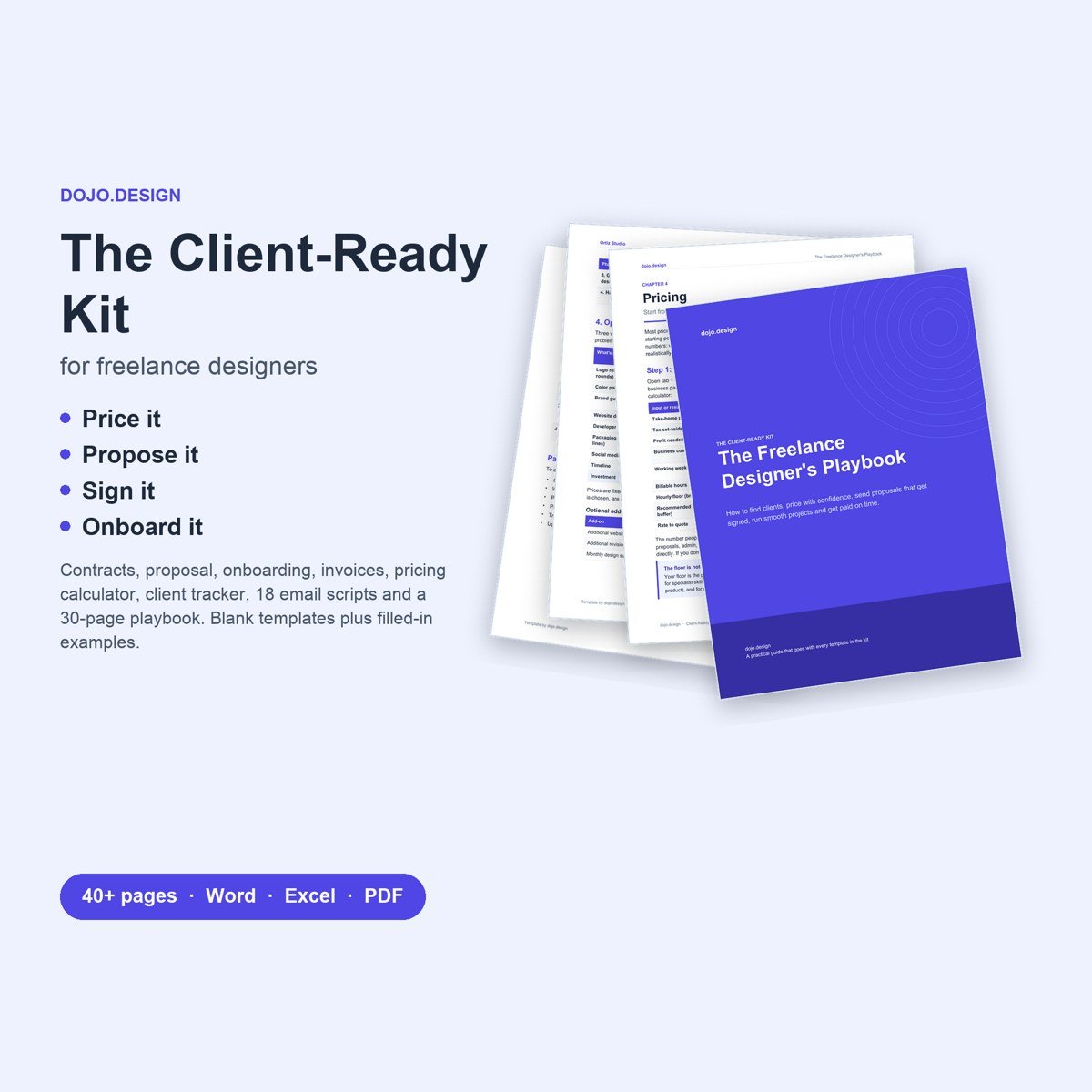
The Client-Ready Kit · $49
Full and short-form design agreements with filled-in examples, project proposal, onboarding questionnaire, welcome packet, creative brief, invoice, pricing calculator, client tracker, 18 email scripts and a playbook.
Get the Client-Ready KitContract + proposal only ($19)What to include
- Deliverables and formats. "Logo design" is not a scope. List each deliverable with its quantity, sizes and file formats, then add a short "not included" list for things clients often assume, such as copywriting, printing and trademark searches.
- Deposit and payment schedule. State the total fee, a non-refundable deposit (40% is a common starting point) and when the rest falls due. Work starts when the deposit clears, and final files go out when the last invoice is paid.
- Revision rounds, defined. Say how many rounds are included and what one round is: a single consolidated set of written feedback from one person. Put a price on extra rounds so nobody has to negotiate later.
- Change orders. A new concept, an extra page or a different audience is a change of scope, not a revision. Quote it in writing, and start only after the client approves by email.
- Feedback deadlines and approvals. Name one point of contact and give them a set number of days to respond. Late feedback moves later dates by at least as much, and a delivery with no answer after one reminder counts as approved.
- Ownership and usage rights. Choose one: assign the copyright once the client has paid in full, or grant a licence for a stated use. Assignment is common for logos and brand identities; licences suit illustration and templates.
- Source files and unused concepts. Say whether layered Figma, Illustrator or InDesign files are included or sold separately. Concepts the client did not choose stay yours.
- Fonts, stock and other third-party costs. These are extra unless the contract says otherwise. Get approval before buying, buy in the client's name where you can, and list the licences at handoff.
- Portfolio rights. Reserve the right to show the finished work once it is public. If a client needs it kept private, that is a request to make before signing, and it can affect the fee.
- Late payment and cancellation. Set a late fee, your right to pause work on overdue invoices, and a kill fee on the unpaid balance if the client cancels partway through, because you turned down other work to hold that time.
- Proofreading and trademark checks. The client approves final text, names and prices, and is responsible for clearing names and marks. You are not running trademark searches unless the contract says you are.
Free: our 19-point client contract checklist and minimum-rate worksheet (2-page PDF).
Download the free checklistMistakes to avoid
- Sending final files before the last invoice is paid
- Writing "unlimited revisions" or leaving the number out
- Handing over ownership on signing instead of on full payment
- Treating a new direction as just another round of changes
- Starting on a friendly email with no deposit
Example wording you can adapt
Plain-English wording for the clauses people most often leave vague. Change the bracketed details to fit how you work.
Revisions. The fee includes [2] rounds of revisions per deliverable. One round is one consolidated set of written feedback from the Client's point of contact. Extra rounds are billed at $[amount] each, confirmed before work starts.
Change in scope. A request that changes the agreed direction, brief, content or quantity is a change in scope, not a revision. No out-of-scope work begins until the Client approves a written change order. An email saying "approved" counts.
Ownership. When the Client has paid all fees in full, the Designer assigns to the Client all copyright in the final, approved deliverables. Until then, the Designer owns all work. Concepts the Client did not select stay with the Designer.
Final files. Final production files are released when all invoices for the project are paid in full.
Kill fee. If the Client cancels, the Client pays for all milestones completed or in progress, plus [25]% of the remaining unpaid fee. The deposit is non-refundable once work has started.
Who owns the design?
Do not assume that paying for a design transfers the copyright. In US law, a transfer of copyright ownership is not valid unless it is in writing and signed by the owner of the rights (17 U.S.C. section 204). An invoice marked paid does not do that job, so the contract should say exactly what passes to the client and when. Rules differ by country, so check yours.
Tying the transfer to full payment gives you real leverage if a final invoice goes unpaid, and it costs a paying client nothing. Most logo and brand identity clients expect to own the result outright, so assignment is the usual choice. For illustration or a template you may resell, a licence for a stated use lets you keep the rights and charge more if the use grows.
Whichever you pick, list the exceptions: fonts and stock images stay under their own licences, and your general tools, techniques and templates stay yours. Those are the items most likely to cause confusion when a client later asks for everything.
Skip the blank page
Every point above is already written into our template, with highlighted fields to fill in and a PDF copy to send. Edit it in Word, Google Docs or Pages.
The Client-Ready Kit · $49
Full and short-form design agreements with filled-in examples, project proposal, onboarding questionnaire, welcome packet, creative brief, invoice, pricing calculator, client tracker, 18 email scripts and a playbook.
Get the Client-Ready KitContract + proposal only ($19)Questions
What should a graphic design contract include?
Deliverables and formats, the fee and payment schedule, revision rounds, change orders, feedback deadlines, ownership and usage rights, source files, third-party costs, portfolio rights, late payment and cancellation.
Who owns a design, the designer or the client?
It depends on the contract. In the US, a transfer of copyright has to be in writing and signed by the owner, so state what passes to the client. Many designers assign the final approved work once it is paid for in full and keep unused concepts.
How much deposit should a graphic designer charge?
Many designers take 30-50% upfront. Our template starts at 40%, non-refundable, with the rest split across milestones and the final payment due before final files.
How many revisions should a design contract allow?
Two rounds per deliverable is a common default. What matters most is defining a round, so that scattered comments from five people do not count as one endless round.
Do I have to give the client my source files?
Only if your contract says so. State whether working files are included, or available for an extra fee.
Is there a short version for small jobs?
Yes. The Client-Ready Kit includes a one-page short-form agreement as well as the full contract. Both come with a filled-in example.
Can I edit it in Google Docs?
Yes. The files are Word documents that open in Google Docs and Apple Pages, with PDF copies included.
More templates for your business: browse the full shop or try the free rate calculator.
Templates are a starting point, not legal advice; laws vary by location. Digital products: all sales are final; faulty file? Email hello@dojo.design and we’ll fix it or refund you.